
Episode 66: Gordon's Alive!!
The Blue Magic Men of Queen Azura

Book Number: 536 = The Mysterious Flame of Queen Loana. Umberto Eco, 2004.
Page Number: 236 = Part Two: Paper Memory = Chapter 11 = Up There at Capocabana.
Hello everyone - warm enough for you?? The random number generator has been in action again and come up with this book which I keep meaning to read on a beach somewhere but never seem to have the mental capacity. It’s about a character who has a stroke which causes him to lose his memory or to be precise his memory of events. He can remember things he’s read, but not his family, what happened to him nor even his name. He chooses to go back to where he was brought up to try and rediscover what happened in his past. Although unsuccessful in regaining his memories he trawls through old papers, vinyl records, magazines, books and relieves the zeitgeist of his generation. Pic below will become clearer, if not less embarrassing, in a few paragraphs…

As per the spoiler above, Eco brings to life a vast array of popular and scholarly references (notably Flash Gordon comics) and also drew on his own life growing up in Benito Mussolini's Fascist Italy:
The hero was Flash Gordon, who thanks to a scheme concocted by a certain Dr Zarkov had landed on the planet Mongo, controlled by a cruel dictator, Ming the Merciless, whose name and features were diabolically Asiatic. Mongo: glass skyscrapers that rose from space platforms, underwater cities, kingdoms stretching through the trees of an immense forest, and characters ranging from the maned Lion Men to the Hawk Men and the Blue Magic Men of Queen Azura, all of them dressed with an easy syncretism, either in outfits that suggested a cinematic Middle Ages, like so many Robin Hoods, or in barbaric lorica and helmets, or occasionally (at court) in the uniforms of cuirassiers or uhlans or dragoons from turn-of-the-century operettas. And all of them, the good and the bad, were incongruously equipped not only with blades and arrows but also with prodigious ray guns, just as their conveyances ranged from scythed chariots to needle-nosed interplanetary rockets in colours as loud as Luna Park bumper cars.
Gordon was beautiful and blond, like an Aryan hero, but the nature of his mission must have astounded me.
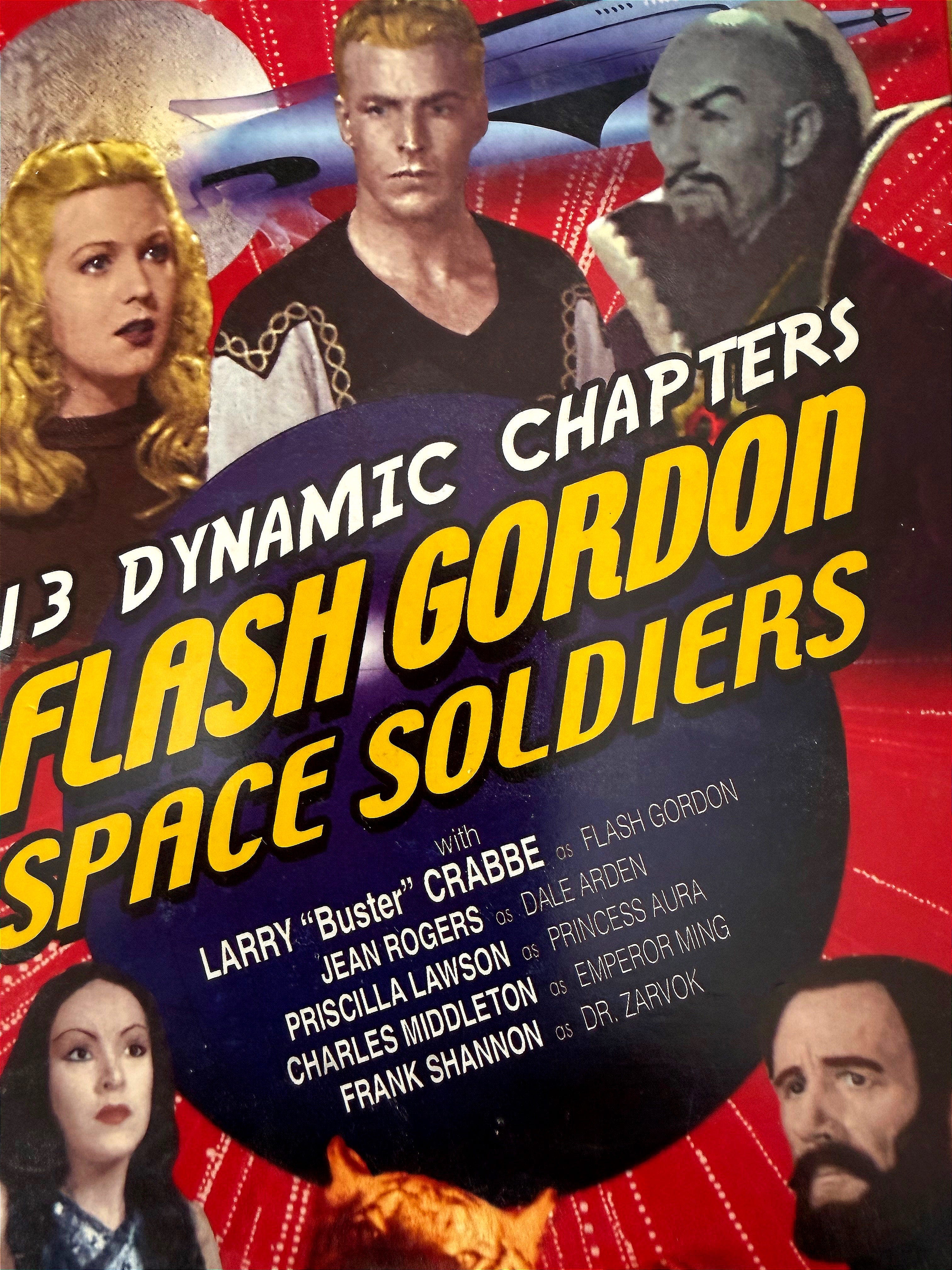
I’ll not spoil the book any further - not least because I’ve yet to read it - but I will plug other Eco works: Foucault’s Pendulum may be my favourite book ever (Dan Brown eat your heart out), the Name of the Rose is ace (particularly if read it while listening to Canto Gregoriana) and Baudolino is great too. And this also gives me the chance to add in this quote (apologies if I have done so before) from Eco which I think summarises things beautifully, but then I’m biased as the writer of a substack about random library shelf choices:
It is foolish to think that you have to read all the books you buy, as it is foolish to criticize those who buy more books than they will ever be able to read. It would be like saying that you should use all the cutlery or glasses or screwdrivers or drill bits you bought before buying new ones.
There are things in life that we need to always have plenty of supplies, even if we will only use a small portion.
If, for example, we consider books as medicine, we understand that it is good to have many at home rather than a few: when you want to feel better, then you go to the ‘medicine closet’ and choose a book. Not a random one, but the right book for that moment. That’s why you should always have a nutrition choice!
Those who buy only one book, read only that one and then get rid of it. They simply apply the consumer mentality to books, that is, they consider them a consumer product, a good. Those who love books know that a book is anything but a commodity.
Toodlepip
As always: Just in case you wondered what the method was for choosing books and pages: https://alexbannister.substack.com/p/prologue-episode-1